
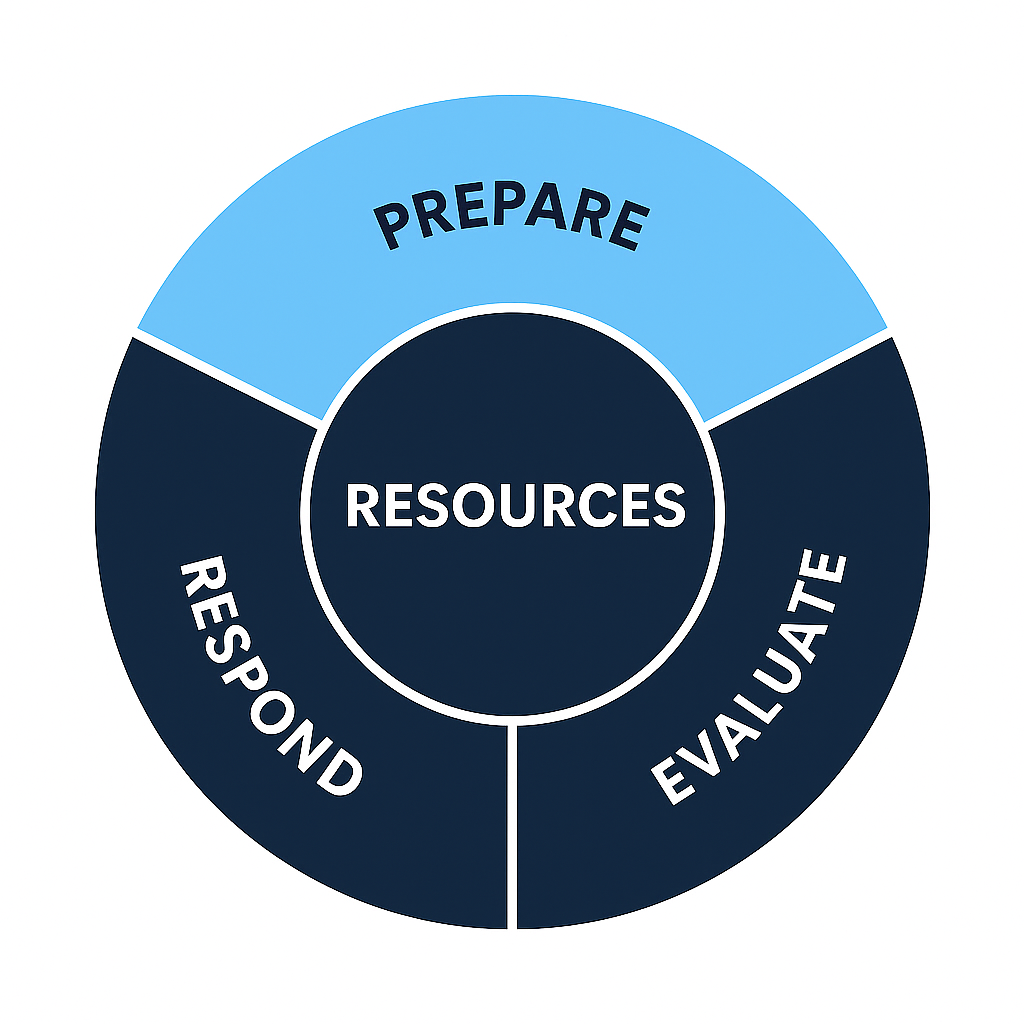
Early Planning Steps
An effective response begins before an overdose anomaly occurs. This section guides jurisdictions through building the infrastructure, partnerships, and protocols necessary to detect, investigate, and respond quickly to overdose alerts.
Four Steps to Prepare for an Anomaly
Preparation is key to timely detection, coordinated response, and efficient resource use. Click on the black headers below to walk through the four steps and ensure your jurisdiction is ready to act quickly when an alert is issued.
Identify Available Data Sources:
To respond effectively to an anomaly, you first need a clear understanding of the data sources available to you. An overdose anomaly can be detected through both formal surveillance (e.g., syndromic surveillance, poison center, mortality data) and informal reporting (e.g., EMS, emergency departments, community partners).
Document Access and Definitions:
Identify and map all available data sources, noting how they can be accessed, how overdoses are defined within each system, and how they can be combined to confirm potential anomalies. Obtain records of interest, including EMS, ED, and hospital records, retrospective data, and any narratives that may be available.
Create Analysis Tools:
Create tools such as line listings to explore potential linkages among related cases by person, place, and time, while being mindful that case linkage or matching should only occur within the bounds of existing data use agreements.
Leverage Key Databases:
Leverage key data sources like SUDORS and PDMPs to track overdoses, identify hotspots, and flag communities or individuals at high risk.
Tool:
Create a comprehensive data catalog of traditional and non-traditional sources using this template.
Use your available data to clarify what constitutes an overdose anomaly. Not every signal requires an immediate response – some may call for ongoing monitoring, while others demand urgent, coordinated action. Defining the anomaly helps clarify causes and guides the scale of response needed. For more guidance on overdose case definitions, view the Develop Case Definitions page.
Consider the following decision-tree to assess common patterns of anomalies.

Setting clear activation thresholds ensures you know when an observed increase in overdoses should move from routine monitoring to response. Thresholds should be locally defined, validated with partners, and aligned with available resources and response capacity. Importantly, jurisdictions should explicitly define the data metric used to identify a deviation from expected patterns (e.g., percent increase, count above baseline, or statistical deviation).
Use the following check list to guide your process:
☐ Establish a baseline
- Use historical overdose data (daily/weekly) to define expected (“normal”) counts
- Select and document the metric that will signal a deviation, such as a percent increase above baseline, a fixed count threshold, or a statistical measure (e.g., counts exceeding a defined number of standard deviations from the mean over a specified time period)
☐ Account for response capacity
- Set thresholds your team can realistically act on
- Avoid overwhelming staff or creating alert fatigue
☐ Build a decision pathway
- Create a decision tree for when alerts escalate into a formal response
☐ Incorporate spatial and temporal considerations
- Define spatial and temporal windows when using statistical tools
- Validate findings with local knowledge
- Test parameters to balance sensitivity and specificity
Create a structured document that outlines response goals, strategies, roles and responsibilities, and operational objectives for a defined period during an overdose anomaly event. Consider the following as you develop your plan:
Summarize the situation:
Define what’s happening, why a response is needed, and the scope of impact. Assess similarities in demographics and characteristics (age, sex, race/ethnicity, area of residence, prescription history, prescribers, where overdosed) and check neighboring areas, such as counties.
Set objectives:
Establish clear, measurable goals aligned with incident priorities and local capacity.
Assign roles & resources:
Clarify responsibilities and resource allocation.
Engage partners :
To align efforts, involve healthcare, EMS, harm reduction, law enforcement, emergency management, and community organizations.
Define strategies:
Outline targeted interventions (e.g., naloxone distribution, community alerts, treatment surge planning) and tailor them to your jurisdiction.Communications plan: Specify how information will be shared across agencies and with the public.
Safety considerations:
Address responder and community safety measures.
Monitoring & evaluation:
Build in mechanisms to track effectiveness, update objectives, and revise plans for each operational period.
👉 For examples and templates, see Montgomery County, OH IAP and additional resources on the Community Response Plan Template.
Strengthening Surveillance: Oklahoma State Department of Health's Data-Driven Approach to Overdose Prevention
The Oklahoma State Department of Health brings decades of experience and strong partnerships to overdose surveillance, including access to consistent, reliable data from a centralized medical examiner system covering all deaths statewide and the Prescription Drug Monitoring Program (PDMP). They have made significant strides in improving access and timeliness by establishing statewide, electronic Emergency Department (ED) data reported monthly and transitioning inpatient discharge data to quarterly reporting with a cloud-based system. While real-time syndromic surveillance and increased overdose detection mapping application program (ODMAP) uptake across the state remain areas for growth, the state has a strong foundation in place, including collaborations with hospitals, local health departments, and poison control. The Oklahoma Office of the Chief Medical Examiner is in the process of updating its statewide case management system, making overdose data even more accessible and actionable. By building on these strengths, the department is well-positioned to expand real-time surveillance and support communities across Oklahoma in responding to overdose challenges.
Continue The Toolkit
< Previous: Prepare Overview
Next: Develop Case Definitions >