
Resources
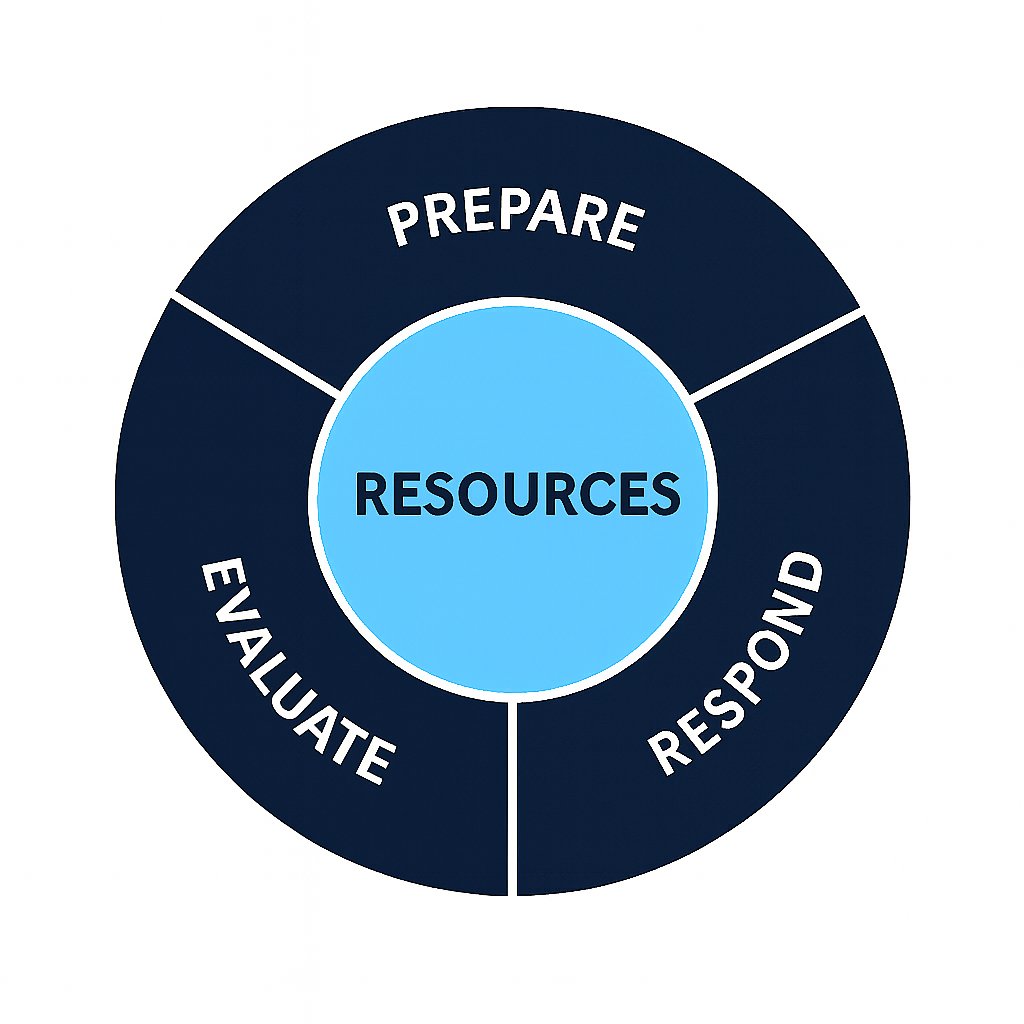
This section provides practical materials to support jurisdictions throughout the overdose anomaly Prepare-Respond-Evaluate cycle. Data and surveillance resources are highlighted to strengthen detection and monitoring, and real-world examples illustrate how jurisdictions have implemented overdose anomaly response. Downloadable tools and templates can support jurisdictions developing case definitions, partner mapping, and communication strategies.
Glossary
The following describe common key terms used throughout the toolkit
Anomaly
Something that deviates from what is standard, normal, or expected.
Epidemic
Large numbers of people over a wide geographic area affected
Alert
An alert is when the total number of suspected overdoses for a jurisdiction exceeds a pre-determined threshold for a specified time
Cluster
An overdose cluster is an event that occurs when more overdoses than expected occur in the same geographic area
Outbreak
(Localized epidemic) More cases of a particular disease than expected in a given area or among a specialized group of people over a particular period of time
Sporadic
A disease that occurs infrequently and irregularly
Endemic
Disease or condition present among a population at all times
Pandemic
An epidemic occurring over a very wide area (several countries or continents) and usually affecting a large proportion of the population
Threshold
A spike in overdose events that exceeds a predefined baseline or alert level, triggering review or response
Data Dashboards & Surveillance Systems
Interactive platforms and national/state tools for overdose data monitoring.
(Click each resource below to expand and access its webpage)
CDC Overdose Data to Action
Grants and strategies to enhance drug overdose surveillance and prevention.
Drug Overdose Surveillance and Epidemiology (DOSE) Dashboard
- Interactive dashboard for nonfatal overdose trends.
Carolina Center for Health Informatics Opioid Dashboards
- Access state and city-specific opioid dashboards across the U.S.
CDC WONDER
- Wide-ranging public health data queries including overdose mortality.
CDC Web-based injury Statistics Query and Reporting System (WISQARS)
- Injury data reporting system, including drug poisoning trends.
The Center for Forensic Science Research & Education | Public Alerts
-
Reports to increase public awareness regarding Novel Psychoactive Substances (NPS) involvement in adverse intoxications, mass overdoses, and fatalities.
The Healthcare Cost and Utilization Project (HCUP)
-
Provides data on hospitalizations and emergency department visits, by patient demographics, diagnoses and procedures, and hospital characteristics.
Overdose Detection Mapping Application Program (ODMAP)
- Free, web-based tool that provides near real-time suspected overdose surveillance data across jurisdictions to support public safety and public health efforts in mobilizing an immediate response to a sudden increase or spike in overdose events
The National Drug Early Warning System (NDEWS)
- Provides the field with timely, salient, and valuable information on emerging substance use trends.
National Electronic Injury Surveillance System (NEISS)
- Injury data system; poisoning queries may help identify overdose events.
National Emergency Medical Services Information System (NEMSIS)
- National system used to collect, store, and share EMS data from the US States and Territories.
National Vital Statistics System
State Unintentional Drug Overdose Reporting System (SUDORS)
Postmortem Toxicology Data
Medical Examiner/Coroner (ME/C) Reports
Syndromic Surveillance & Essence Tools
Guidance and advanced tools for working within the NSSP ESSENCE platform.
Querying & Visualization
- Query Wizard: The Query Portal permits users to select specific populations to perform analysis for specific medical conditions over various time periods and geographical locations. ESSENCE analysis, visualizations, and export features are available within the portal. Once custom analysis features are selected, they can be sent to the myESSENCE and myAlerts for use in routine analysis and alerting.
- Advanced Query Tool: The advanced query tool allows users to create more complex queries than using the standard filters in the Query Wizard
- myESSENCE Dashboards: The myESSENCE feature allows you to create customizable dashboards of frequently used graphs, charts, tables, maps, and alerts
- Time Series Viewer: Allows users to analyze a time series graph produced after performing a query.
- Data Details: Data details drill down to the underlying data for a particular query
- Building, Using, & Sharing Queries – Recorded tutorials on how to build, use, and share queries in ESSENCE.
Free-Text Queries & Coding Series
- Free-Text Queries: Introduction to free-text queries using the Query Wizard.
- Free-Text Coding Series: 6-part series to improve free-text query writing using ESSENCE.
Alerting Algorithms
- myAlerts: Custom alerts for specific populations or conditions
- Algorithms: Temporal, spatial, time of arrival (TOA), fusion, and word alerts
- Jurisdictional Usage of the New ESSENCE Word Alert Feature: Describes the new word alert capability in ESSENCE, how it has been used by the Florida Department of Health and how the word alert feature works to find individual chief complaint terms that are occurring at an abnormal rate.
- What Can You Do with 35,000 Alerts a Week?: Find practical ways to sort through statistical noise in syndromic data and make use of alerts most likely to have public health importance.
- Analytic Fusion for Essential Indicators of the Opioid Epidemic: In a partnership between the Public Health Division of the Oregon Health Authority (OHA) and the Johns Hopkins Applied Physics Laboratory (APL), an analytic fusion tool was developed using streaming data and report-based evidence to improve the targeting and timing of evidence-based interventions in the ongoing opioid overdose epidemic.
- Alert Fatigue: Causes and Remedies: how to address alert fatigue, a condition experienced by users of an automated surveillance system when they lose confidence in the value of the system-generated signals.
R Products and Packages
- Rnssp Package: R package developed by NSSP facilitates access to data within ESSENCE via a secure and simple interface. A tutorial is available.
- How to Use RStudio with ESSENCE API Guide: An overview of the ESSENCE APIs and how to access them through RStudio.
- NSSP-R User Group Call Archive: The NSSP R User Group provides NSSP R updates to its members and answers community questions on about NSSP R-specific functions and features.
- Interacting with Web Data using R: Web APIs and Web Scraping (including RSelenium): A webinar that demonstrates working with an API from R to extract information from healthdata.gov. It also demonstrates scraping static web content using the rvest package, and how to scrape static content by driving a web browser using RSelenium.
- An Introduction to RStudio & R Markdown – Beginner & Intermediate: This webinar delivers a beginner‑to‑intermediate overview of using RStudio and R Markdown for reproducible analyses, focusing on tools and workflows tailored to biosurveillance practitioners.
- Interactive Reporting & Dashboards in R Markdown – Intermediate & Advanced: This intermediate-to-advanced webinar demonstrates how to create interactive, publication-quality reporting dashboards using R Markdown (including flexdashboard and Shiny integration) to enhance real-time analysis and communication in biosurveillance workflows
- New Features in R Markdown & HTML Widgets – Intermediate & Advanced: This intermediate-to-advanced webinar showcases the latest enhancements in R Markdown, particularly HTML widgets integration, for creating dynamic, interactive content tailored to biosurveillance reporting workflows.
- Making Report-Quality Plots in R with Low-to-Moderate Coding Experience: This webinar demonstrates the ‘ggplot2’ package and how to create a plot by looking at the components that make up its overall structure. It will also go into how these graphics can be integrated into RMarkdown to create an automated report that is visually appealing.
- Opioid Overdose Surveillance and Classification with R: In this webinar, Marin County, California is addressing the lack of clarity in opioid overdose data by designing a novel cloud-based system to identify opioid overdoses for both surveillance and outreach purposes using county-owned Emergency Medical Services (EMS) data.
- Leveraging the NSSP R Studio Server to Automate QA Monitoring and Reporting: The aim of this project was to develop a nimble system to both monitor and report on the quality of Kentucky emergency department syndromic surveillance data at system-wide and facility levels.
Continue The Toolkit
< Previous: Designing Your Evaluation
Next: Policy, Program Planning, and Evaluation >